

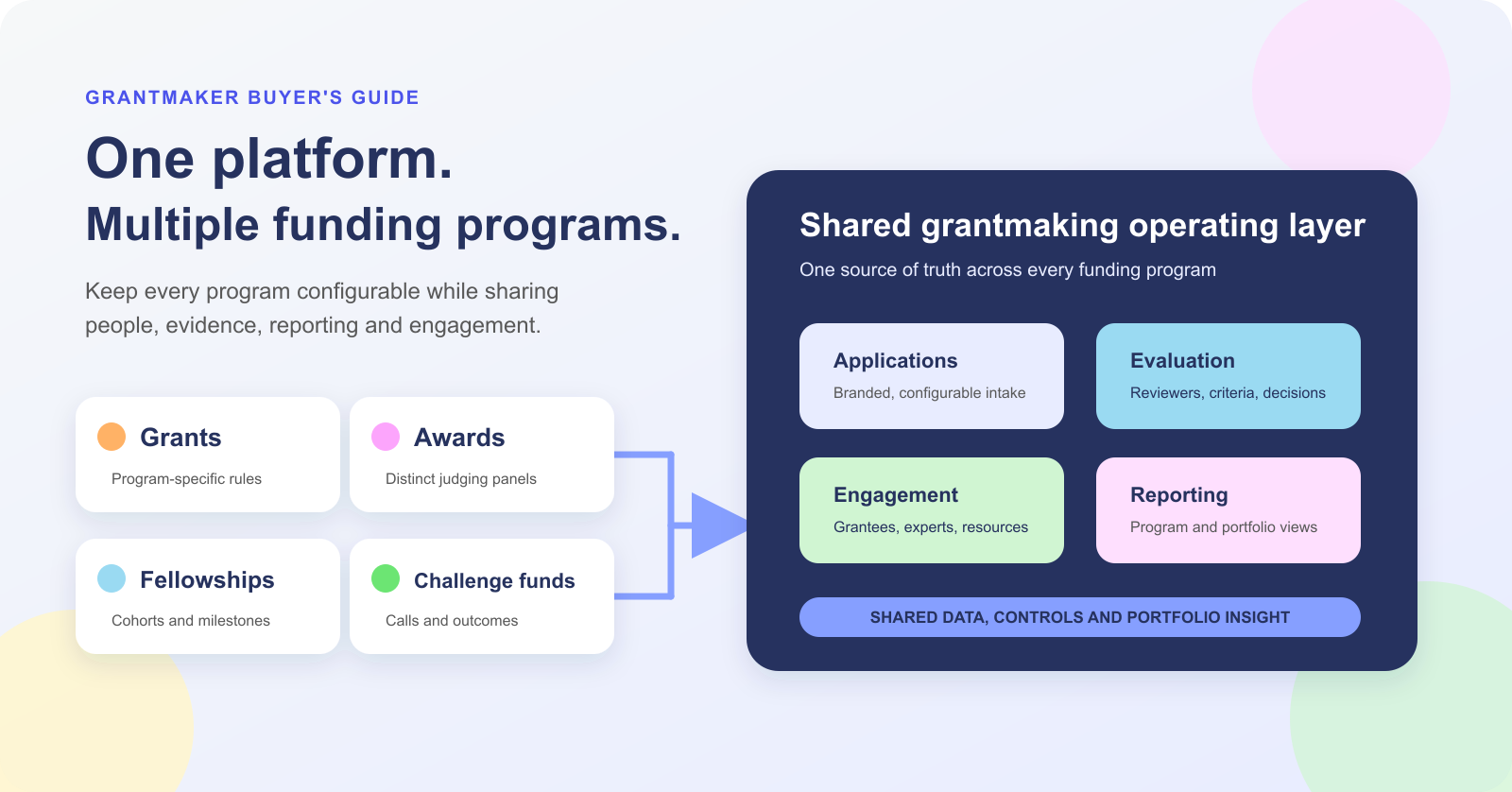


Choosing grant management software is not simply a matter of digitizing an application form. Grantmakers use these systems to design funding programs, collect and screen applications, coordinate reviewers, document decisions, administer awards, gather post-award reports, and analyze results. The challenge for organizations managing multiple programs is finding software that can accommodate different requirements without creating fragmented data, inconsistent processes, or unnecessary administrative work.
Is the software for grantmakers or grant seekers?
The phrase grant management software is used for two very different jobs. A grantmaker manages programs and awards. A grant seeker finds opportunities, prepares applications, tracks restricted income, and reports back to funders. Search results often mix both audiences, so the first buying decision is to confirm which side of the relationship a product is built to serve.
A grantmaker-facing system should create a controlled route from program design to reported outcome. Grants.gov describes the grant lifecycle as pre-award, award, and post-award stages, with distinct responsibilities for the organization awarding funding and the organization applying for it.[1] Independent grants-management research similarly treats a grants management system as software supporting the full grant cycle.[5]
| Buyer | Primary job | Typical capabilities | Relevant search intent |
|---|---|---|---|
| Grantmaker or funder | Design, award, govern, and learn from funding programs | Application intake, eligibility, reviewer assignment, scoring, approvals, award tracking, post-award reports, portfolio analysis | Grant management software, grant management system, grantmaking software |
| Grant seeker or recipient | Find and apply for funding, then administer received grants | Opportunity search, proposal writing, calendars, restricted-fund accounting, expense tracking, funder reporting | Grant search software, grant writing software, grant accounting software |
If your organization awards funding, judge products against the complexity of your programs and stakeholders, not against the longest generic feature list. A useful starting point is Skipso's overview of grant management software for program operators.
What should a grant management system connect?
A grants management system should connect the complete decision chain: the purpose of the program, the information supplied by applicants, the criteria used by reviewers, the rationale for an award, the milestones agreed with a grantee, and the results reported later.
That connection matters because post-award reporting should not begin as a separate record with no relationship to the original application. US federal guidance describes award management systems as connecting application, management, reporting, and closeout processes.[2] The details vary outside government, but the operating principle is useful for any grantmaker.
Eight connected stages
- Design the program.Define purpose, eligibility, budget, dates, assessment criteria, governance, and intended outcomes.
- Publish clear guidance and forms.Give applicants a branded, accessible route to understand the opportunity and submit the right evidence.
- Screen consistently.Check completeness and eligibility before scarce reviewer time is committed.
- Review against agreed criteria.Assign the right evaluators, collect scores and comments, and manage conflicts of interest.
- Make and record the decision.Preserve approvals, rationale, conditions, and communications in one decision record.
- Hand off into the award.Carry the approved scope, terms, budget, milestones, and reporting expectations forward.
- Monitor delivery.Collect progress, evidence, reports, changes, and actions against the award.
- Learn across the portfolio.Turn program data and reported outcomes into reusable insight for the next funding cycle.
Why do multiple funding programs change the requirements?
One program can sometimes be managed with a form, a spreadsheet, and determined staff. Complexity rises quickly when an organization operates several funds, regions, departments, or program types. Each may require different eligibility rules, application questions, reviewer panels, scorecards, stages, calendars, budgets, languages, and reporting obligations.
The answer is not to force every program into one rigid template. It is to create a shared operating layer in which each program remains configurable while people, controls, evidence, and reporting can be reused where appropriate.
The decisive multi-program question
Can every program have the workflow and experience it needs without creating another disconnected database, another reviewer list, and another reporting process?
A connected approach is particularly valuable when grants sit alongside awards, fellowships, scholarships, community investment, or challenge funds. These programs are not identical, but they often share applicants, experts, evaluators, partners, governance requirements, and reporting needs. A broader program management platform can provide that common foundation without erasing program-specific rules.
Which type of grant management platform are you comparing?
Grantmakers may compare forms and spreadsheets, application management software, and grant management systems. Their capabilities overlap and vary by product. These are alternative approaches to running the work, not successive stages that every organization must progress through.
| Tool type | Strongest at | Typical output | Question to test |
|---|---|---|---|
| Forms, spreadsheets, and project tools | Lightweight intake and internal task coordination | A submission list and manually maintained process | What happens to permissions, scoring, version control, and reporting as volume grows? |
| Submission or application management software | Forms, deadlines, communications, and initial review | A managed application and selection process | Does the record continue through awards, milestones, outcomes, and portfolio reporting? |
| Grant lifecycle management system | Applications through award administration and reporting | A connected grant record | How configurable, usable, branded, and integration-ready is it for your mix of programs? |
Start with the approach that covers your requirements with an appropriate level of setup and administration. Some products provide predefined workflows; others offer extensive configuration within the same category. The next question is whether bringing work currently spread across several tools into one platform would create enough value to justify the change.
What features should a grantmaker score?
Translate features into buyer outcomes. This makes demonstrations easier to compare and prevents a visually impressive portal from hiding gaps in governance, reporting, or post-award work.
Applicant and grantee experience
Clear guidance, accessible forms, draft saving, status visibility, communications, and a low-friction journey on desktop and mobile.
Configurable workflows
Program-specific forms, conditional logic, eligibility rules, stages, templates, deadlines, and permissions without a custom rebuild.
Review and scoring
Reviewer assignment, multiple evaluation phases, weighted scorecards, comments, blind-review options where needed, and conflict declarations.
Governed decisions
Role-based access, approvals, decision rationale, change history, communications, exports, and an accessible audit trail.
Post-award management
Milestones, progress updates, tasks, KPIs, budget tracking, documents, amendments, and outcome reporting tied to the original award.
Portfolio visibility
Program and cross-program dashboards, segmentation, outcome analysis, exportable data, and reporting for leadership or boards.
Engagement after selection
Persistent grantee profiles, directories, resources, events, messaging, recommendations, and opportunities to connect participants.
Brand, data, and delivery
True white-label options, data migration and portability, security, integrations, implementation ownership, training, and support.
For a deeper treatment of assessment design, see Skipso's guide to the grant application review process.
Why does true white-label grant software matter?
The public-facing experience is part of the program. Applicants are more likely to trust guidance, communications, and data requests when the journey clearly belongs to the grantmaker. A logo placed on a vendor-branded portal is not the same as a genuinely white-label service.
Ask how far branding and ownership extend across the experience:
- Custom program landing pages: Can your team build and adapt pages for different grants without waiting for a separate website project?
- Your own domain: Can the opportunity and applicant portal sit on a client-owned domain rather than an unfamiliar software address?
- Consistent visual identity: Can you configure colors, fonts, navigation, page copy, headers, footers, and the login experience?
- Branded communications: Can status updates and automated notifications be sent from the client's own email address, with appropriate setup and authentication?
- Program-level flexibility: Can distinct programs vary their pages and messaging while still feeling part of one funding organization?
This is more than a design preference. It reduces the handoff between the corporate website and the application system, gives communications teams greater control, and lets each funding opportunity explain its purpose and requirements clearly. It can also support search visibility when public program pages have configurable SEO fields and useful indexable content.
What should a grant-management audit trail record?
Governance should make funding decisions explainable without turning every action into manual administration. The UK's government grants standard emphasizes governance, approvals, data capture, transparency, accountability, and an appropriate audit trail.[4] An audit trail supports those aims, but it does not by itself guarantee legal or regulatory compliance.
| Evidence | What the record should show | Why it matters |
|---|---|---|
| Who | User, role, reviewer, approver, or administrator responsible for the action | Establishes accountability and supports access reviews |
| What | Submission, score, comment, status, field, document, approval, or communication changed | Shows the substance of the action |
| When | Timestamp and relevant program stage or deadline | Reconstructs the sequence of events |
| Where | Program, application, award, grantee, and affected record | Connects activity to the correct funding decision |
| Why | Decision rationale, conditions, exception, or approval context where required | Makes consequential choices explainable |
| Change and export history | Previous value where retained, new value, and exports performed | Supports assurance, investigation, and reporting |
Good governance also needs clear ownership. The Council on Foundations recommends grants-management practices that are communicated to internal and external stakeholders and structured to support grantee success.[3] Software can preserve the process, but people still define the policy and own the decision.
When should you consolidate your grant programs into one platform?
Consolidation becomes a priority when maintaining separate tools creates repeated data entry, fragmented decisions, inconsistent applicant experiences, or reporting that takes substantial manual work. A configurable platform can bring application intake, evaluation, program administration, public pages, reporting, and participant engagement into one environment. The benefit depends on which existing workflows it can replace.
Focused software with predefined workflows can be a good choice when its standard process matches your needs. Configuration becomes more valuable when different programs require different rules, branding, stakeholder roles, or support after selection. These are buying considerations, not fixed boundaries between product categories.
| A focused grant tool may be sufficient when... | A configurable platform becomes a priority when... |
|---|---|
| Programs follow a similar, standard process. | Programs need different forms, stages, reviewers, and permissions. |
| Standard templates and branding meet requirements. | Landing pages, domains, branding, and email identity need to belong to the funder. |
| Applications and decisions are the main administrative task. | Teams also coordinate milestones, reporting, resources, and participant support. |
| Separate program reports are sufficient. | Leadership needs visibility across multiple programs. |
| Engagement largely ends after the award. | Grantees, experts, reviewers, and partners remain involved between funding cycles. |
| Fast setup with minimal configuration is the priority. | Consolidating tools and accommodating operational complexity justify more setup and process design. |
Compare what you can retire with what you need to configure
List the tools currently used for grant landing pages, forms, reviewer scoring, program tracking, reporting, and participant communications. For each, identify the functions a proposed platform can cover, any gaps, and whether the existing tool can actually be retired. Then weigh reduced administration and duplicate subscriptions against migration, configuration, training, and ongoing ownership.
For example, a funder running community grants, fellowships, and challenge funds may be able to reuse participant profiles, program templates, and reporting across all three. Another funder with one stable annual process may get little additional value from that flexibility. A capable grant management system may already cover your requirements; consolidation should solve a demonstrated operating problem.
Make the consolidation case concrete
Ask the supplier to demonstrate the workflows you can bring together, the tools you could retire, and the systems you will retain. Judge the value against your program needs and the effort required to implement the change.
Fund accounting or ERP, payment rails, electronic signature, identity and SSO, specialist due diligence, CRM, and enterprise business intelligence may still be required. Confirm how the selected platform will connect records and responsibilities across those systems.
Where can AI help without making the funding decision?
AI can reduce administrative work when it is applied to well-defined tasks and kept inside a governed process. Useful applications can include drafting form structures, summarizing submissions, comparing evidence with published criteria, helping route applications, identifying patterns across a portfolio, recommending relevant content or connections, and preparing first-draft reports.
The controls matter as much as the capability. Buyers should ask what information the AI uses, who can see its outputs, whether prompts and criteria can be configured, how results are reviewed, and what is logged. AI should support evaluators and program teams. Human decision-makers should retain responsibility for awards.
What should you ask before a grant software demo?
Bring examples from your real operating model, including the simplest program and the most complex. Ask the supplier to demonstrate those scenarios rather than presenting only a polished default workflow.
- Can we create different forms, stages, scorecards, roles, and communications for each program?
- Can program teams reuse templates without copying stale records or permissions?
- How are reviewers assigned, conflicts declared, scores reconciled, and approvals recorded?
- Can applicants and grantees save drafts, collaborate, upload documents, and see relevant status updates?
- How much of the public landing page, portal, login experience, domain, fonts, colors, and copy can we control?
- Can automated notifications be sent from our own email address, and what technical setup is required?
- How do awards, milestones, changes, reports, KPIs, and outcomes remain linked to the application?
- What can leadership see across programs, and can the underlying data be exported?
- Which integrations are standard, which require configuration, and who owns them?
- How will existing applications, contacts, documents, and history be migrated and validated?
- What implementation work is included, and what drives subscription, setup, integration, and support costs?
- Can we export our data in usable formats if our needs change?
How can Skipso help consolidate grant and program management?
Our platform can bring together work that grantmakers otherwise manage across website tools, application and review systems, spreadsheets, and participant communications. This is most valuable when an organization runs several distinct programs, needs full control over its public experience, and wants to maintain relationships after selection.
With our page builder, teams can create and adapt branded program landing pages. We support client-specific colors, fonts, navigation, content, login experiences, headers and footers, plus custom-domain hosting where configured. Automated notifications can be sent from the client's own email address, helping the funding journey feel consistent from the first program page through subsequent updates.
Behind that experience, our configurable forms, evaluation phases, scorecards, reviewer assignments, role-based participation, dashboards, audit logging, exports, tasks, KPIs, and budget tracking can reduce the need for separate tools used to coordinate program work. Where ongoing engagement matters, profiles, directories, resources, events, messaging, newsletters, recommendations, and matchmaking can support grantees, awardees, reviewers, and partners between funding cycles.
That combination can replace parts of an existing application, review, or grant administration setup where our configured workflows meet the requirements. We assess this against the actual process and data, including any specialist finance, payment, or compliance functions that need to remain in other systems. Configuration, migration, integration, and team ownership should be part of the buying decision.
If a standard grant tool already covers your programs with little administration, a broader setup may not be a priority. Our strongest fit is where bringing several workflows and participant relationships together creates a clear operational benefit.
Grantmakers that also run recognition programs can explore our awards management capabilities, while public-sector teams may find our separate guide to government grant management useful.
Frequently asked questions
What is grant management software for grantmakers?
It is software used by organizations that award funding to design programs, receive and screen applications, coordinate reviewers, document decisions, administer awards, collect reports, and analyze results. It is different from software that helps applicants find or apply for grants.
What features should a grantmaker look for?
Prioritize configurable workflows, applicant experience, eligibility screening, reviewer management, scoring, approvals, audit history, award and milestone tracking, post-award reporting, portfolio dashboards, data portability, security, and implementation support. Add community or ecosystem features when ongoing engagement is part of the program model.
Can one platform manage multiple grant programs?
Yes, if each program can have its own forms, stages, rules, roles, communications, and reports while sharing approved data, templates, controls, and portfolio views. Avoid systems that achieve consistency only by forcing every program into one rigid workflow.
Does grant management software replace accounting software?
Usually not. A program platform manages applications, decisions, awards, reporting, and stakeholder workflows. Fund accounting, ERP, payment, tax, and banking systems retain specialist financial responsibilities and may need to exchange data with it.
What is the difference between application management and grant lifecycle management?
Application management concentrates on intake, review, and selection. Grant lifecycle management continues through award administration, milestones, changes, reporting, closeout, and portfolio learning. Product labels vary, so test the workflow rather than relying on the category name alone.
Can the same system manage grants, awards, fellowships, and scholarships?
A configurable platform can support these related funding and recognition programs, provided their distinct eligibility, evaluation, cohort, privacy, and reporting requirements can be modeled separately.
How should buyers compare grant management software pricing?
Compare total cost against your actual program portfolio. Ask what is included for programs, users, applications, customization, domains, page design, data migration, integrations, dashboards, support, and storage. Avoid comparing headline subscription prices when the implementation scope is different.
How does post-award reporting support portfolio learning?
When reports, milestones, and outcomes remain linked to the original application and decision, teams can compare intended and delivered results, identify recurring barriers, and use evidence from one cycle to improve the next.
When is a configurable grant management platform worth the setup?
It becomes more valuable when programs need different workflows, full control over branding, reporting across programs, or sustained participant engagement. Compare the tools and manual work you could retire with the cost of configuration, migration, training, and ongoing administration. A focused product may be sufficient when its standard process already fits.
Key takeaways
- Use grant management software as the recognized category, then confirm the product is designed for grantmakers rather than grant seekers.
- Prioritize configuration when different program requirements and the work of maintaining separate tools justify the additional setup.
- Treat true white-label delivery as a trust and ownership requirement, including landing pages, branding, domains, and communications.
- Connect the full lifecycle so the application, decision, award, reporting, and outcome remain part of one evidence chain.
- Choose ongoing engagement capabilities when grantees, experts, reviewers, and partners need to stay involved after selection.
- Keep human accountability for funding decisions and connect specialist finance or compliance systems where required.
Explore a grantmaker workflow built around your programs
Bring one straightforward program and one complex program. We will show how Skipso can configure the applicant experience, evaluation, governance, reporting, white-label delivery, and post-award engagement around both.
Request a tailored demo


