




Supplier Innovation Marketplaces: How Enterprises Find, Evaluate and Scale New Suppliers
Traditional supplier portals manage known vendors. A supplier innovation marketplace helps organisations discover unfamiliar capabilities, run fair evaluations and turn promising solutions into governed pilots and scalable outcomes.
A supplier innovation marketplace is a continuously accessible digital environment where an organisation can discover emerging suppliers, publish unmet needs, match capabilities to opportunities, evaluate solutions, govern pilots and retain the resulting supplier intelligence. It is broader than a supplier portal and more operational than a supplier directory.
Large organisations rarely suffer from a shortage of suppliers. They suffer from a shortage of reliable ways to find the right new suppliers, assess unfamiliar solutions and move them through the gap between an interesting introduction and a deployable outcome.
That gap matters most when the need is novel. An existing supplier list may be excellent for categories the organisation already understands, but much less useful when a business team needs a technology, capability or delivery model that did not exist when the list was created. Siemens has described this problem directly: established supplier panels can reach their natural limits when new technologies are required.1
This is why organisations are exploring a new layer in their procurement and innovation infrastructure: the supplier innovation marketplace. The phrase is still emerging, but the operating model is visible across corporate open innovation, challenge-led procurement, supplier discovery and dynamic supplier markets.
What is a supplier innovation marketplace?
A supplier innovation marketplace gives external organisations a clear front door and internal teams a governed route from discovery to decision. It can combine a searchable supplier network, open calls, proactive scouting, challenge publication, intelligent matching, structured evaluation, pilot management and outcome tracking.
“Marketplace” does not have to mean an ecommerce catalogue. In this context, it describes a living environment in which demand and capability can find each other. A business team can publish a problem. Relevant suppliers can respond or be proactively identified. Reviewers can assess them against the same criteria. Strong candidates can progress into due diligence, pilots and formal procurement without losing the evidence gathered along the way.
The market does not consistently distinguish a supplier innovation marketplace from a supplier innovation platform. In this guide, “marketplace” describes the operating model—the participating suppliers, business needs and engagement process—while “platform” describes the technology that enables it. They are two perspectives on the same emerging model, not separate product categories.
Skipso's partner and supplier marketplace is designed around that wider lifecycle: attracting organisations, maintaining reusable profiles, matching needs to capabilities, evaluating opportunities and tracking relationships over time.
Portal, discovery platform or innovation marketplace?
The terminology matters because supplier portals, discovery platforms and innovation marketplaces solve related but different problems. A team looking for “supplier discovery” may only need a richer dataset and shortlist. A team building a repeatable path from unmet need to validated supplier needs more.
The categories can overlap. A mature supplier innovation marketplace will usually include discovery and portal capabilities, delivered through a supplier innovation platform. Its defining feature is not the directory or the product label; it is the connected decision workflow around it.
Why are organisations moving towards supplier innovation marketplaces?
The shift is being driven by structural changes in the market, not by a desire to add another portal. It builds on the more established procurement discipline of supplier collaboration and innovation, but extends participation beyond a small group of strategic incumbent suppliers.
1. New capabilities increasingly sit outside the incumbent supply base
Emerging technologies are often developed by specialist SMEs, scale-ups, startups and research-led businesses that have no existing vendor relationship with a large buyer. Waiting for those organisations to appear in a conventional sourcing process makes discovery dependent on awareness, timing and procurement fluency.
A marketplace creates two routes at once: suppliers can respond to visible opportunities, while the buyer can proactively scout for organisations that match a defined need. This is more resilient than relying on inbound submissions alone.
2. Administrative burden filters out the suppliers buyers want to reach
Controls are necessary, but applying every control at the first interaction can make an exploratory opportunity feel like a full tender. OECD research on SME participation in public procurement identifies complexity, administrative burden and demanding requirements as disproportionate barriers for smaller organisations.2
A better model asks for the information needed at the current stage, then increases evidence requirements as the opportunity becomes more serious. A reusable profile prevents the same supplier from repeatedly entering basic information. This does not remove governance; it sequences governance intelligently.
3. Static lists age quickly in emerging and niche markets
Recent public-procurement reforms illustrate the direction of travel. UK guidance defines dynamic markets as lists of qualified suppliers that remain open to new entrants, with no fixed limit on supplier numbers. Official training highlights their usefulness in emerging and niche markets and where a large base of SMEs can increase competition and innovation.3
The broader principle applies beyond government: if the relevant market is changing rapidly, the engagement mechanism must be capable of learning and admitting new participants continuously.
4. Buyers are organising discovery around problems, not catalogues
Challenge-led models begin with an outcome the organisation needs rather than a predefined product specification. This opens the field to suppliers whose solutions may be unfamiliar to the buyer or may cross conventional category boundaries.
OECD reviews of innovation procurement describe operating models that combine an innovation marketplace, where companies can present solutions, with challenges published when buyers cannot find a suitable existing solution. Other examples match public-sector needs with national innovators through a shared platform.4
5. Discovery has to connect to pilots and adoption
A long supplier list is not an innovation outcome. The difficult work begins after discovery: evaluation, internal sponsorship, due diligence, pilot design, approvals, evidence collection and the decision to scale.
The European Innovation Council's innovation procurement programme reflects this full journey. It combines buyer opportunities, competitive selection, funded pilots and support for follow-on deployment. The programme identifies access to first customers as a major barrier for innovative SMEs.5
6. Supplier knowledge has become an asset worth retaining
In a fragmented process, every challenge creates another spreadsheet and every team rebuilds market knowledge from scratch. In a marketplace, supplier profiles, assessments, decisions, interactions and outcomes accumulate in a searchable network.
A supplier that is unsuitable for one brief may be ideal for another six months later. Retaining the relationship means the cost of outreach and evaluation compounds into institutional intelligence rather than disappearing into an inbox.
The market signal
Across procurement policy and corporate open innovation, the same pattern is appearing: lower-friction entry, continuously refreshed supplier pools, challenge-based demand, structured evaluation and a clearer route from pilot to adoption.
How a supplier innovation marketplace works
The strongest operating model connects seven stages. Each stage produces structured information that the next stage can use.
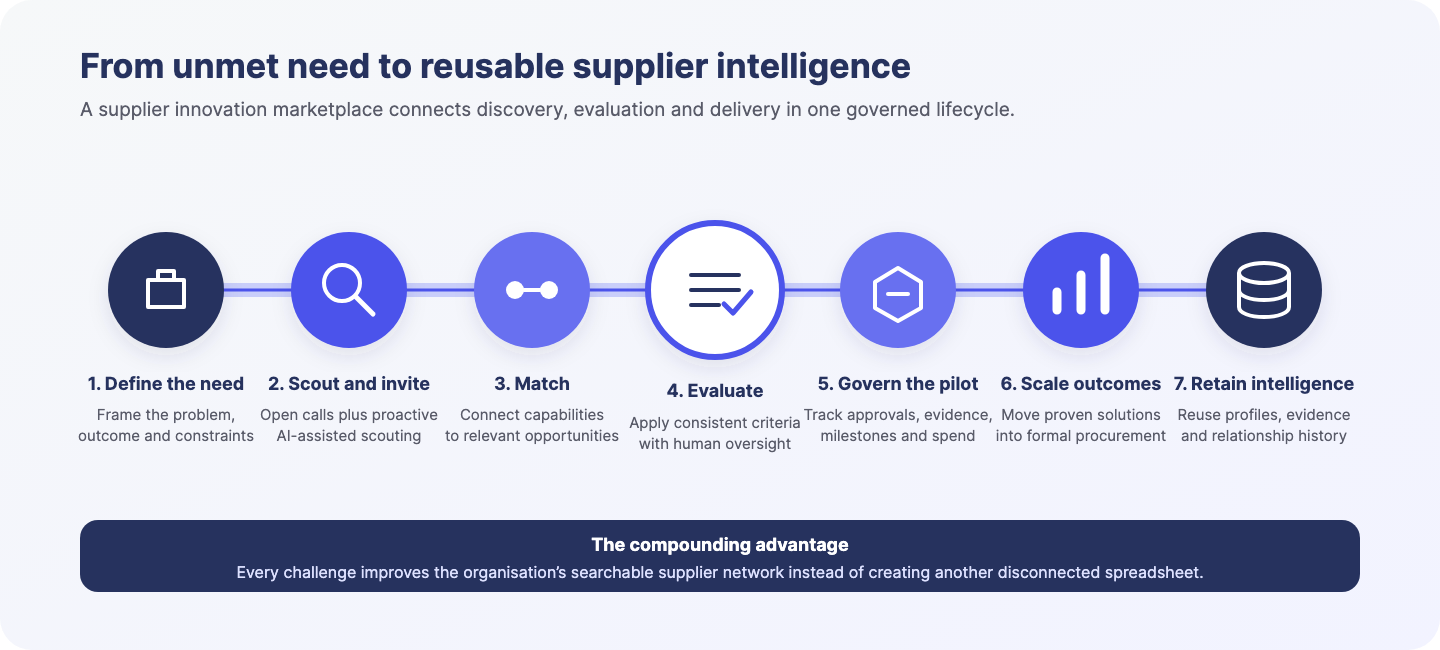
Define the need in outcome language
A strong brief explains the problem, intended outcome, environment and constraints without prescribing an unnecessarily narrow solution. Internal stakeholders should agree what evidence will distinguish relevance, feasibility, strategic fit and adoption potential.
Combine open applications with proactive scouting
A branded opportunity page gives suppliers a credible reason to engage. Proactive research reaches organisations that do not monitor procurement portals or do not yet recognise themselves as suppliers to the buyer. Skipso's AI for innovation capabilities can support external scouting, eligibility checks and structured analysis against a brief, while the decision remains with human reviewers.
Match capabilities to live opportunities
Matching should go beyond category labels. A useful model considers the business need, technical capabilities, deployment context, maturity, geography and other programme-specific constraints. Explainable fit signals help reviewers understand why a supplier was surfaced.
Evaluate consistently and in stages
Different opportunities require different experts. Role-based review, weighted scorecards, conflict management, comments and decision records help distribute the work without losing consistency. Configurable programme-management workflows allow deeper questions and checks to appear only when a supplier progresses.
Govern pilots as part of the same record
A selected supplier should not fall into a separate spreadsheet. The marketplace can retain the original need, evaluation evidence, agreed milestones, risks, approvals and pilot outcomes. Where a programme includes credits, vouchers or funded pilot allowances, a configurable ledger can record allocations, approvals and usage alongside the engagement.
Handoff proven suppliers to formal procurement
The marketplace should make the transition into due diligence, contracting and purchasing easier by passing forward clean data and a defensible decision history. It should not duplicate the systems designed to manage contracts, purchase orders and payment.
Keep the ecosystem active after each opportunity
Updates, events, targeted introductions and new challenges keep relevant suppliers connected. Over time, an innovation ecosystem platform can reveal where capability is growing, where relationships are underused and which suppliers have already built credibility with the organisation.
Where does it fit in the procurement technology stack?
A supplier innovation marketplace is an engagement and decision layer, not a replacement ERP. It manages the uncertain, collaborative journey before a new supplier becomes a routine transaction.
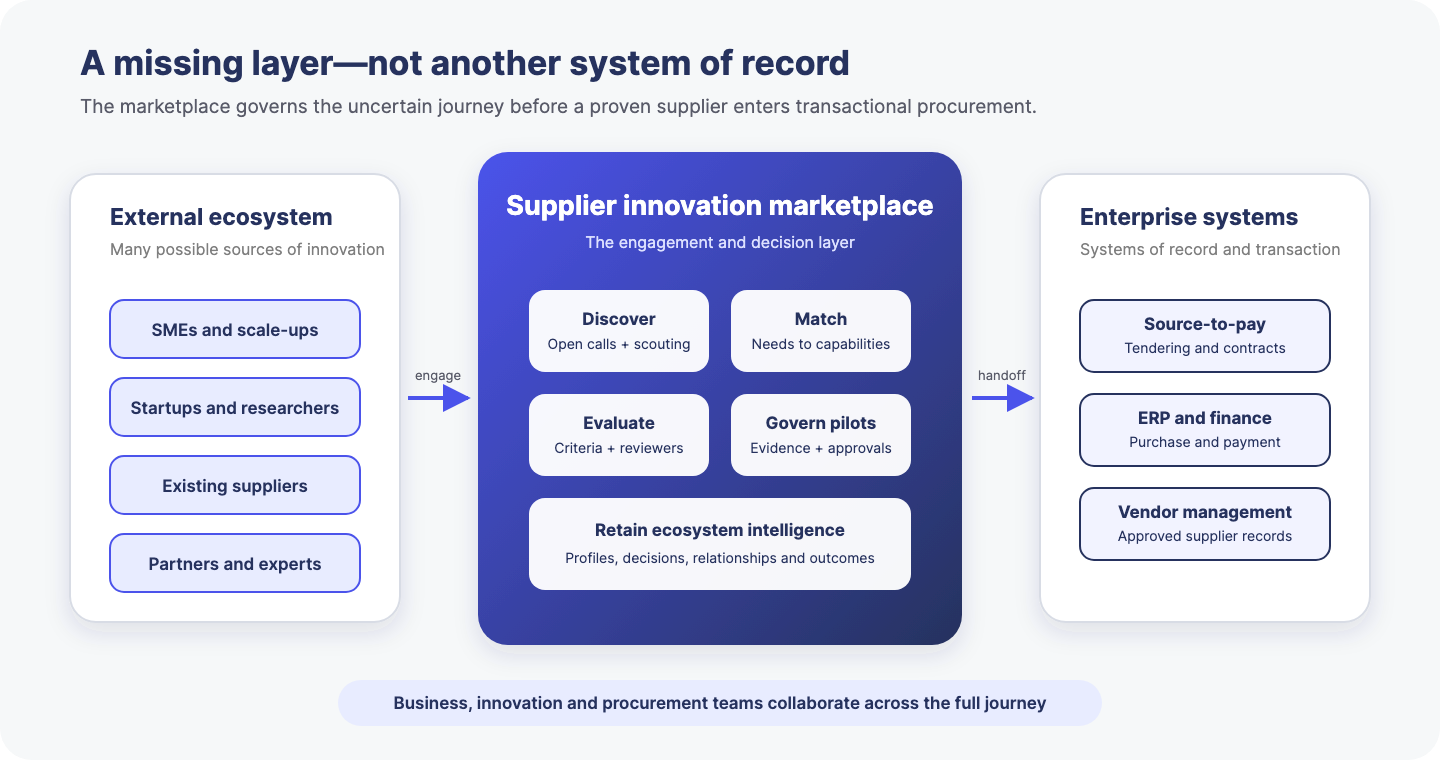
The marketplace connects the external ecosystem to enterprise systems while keeping discovery, matching, evaluation and pilot evidence together.
This system boundary prevents two common mistakes. The first is forcing early-stage innovators through a transactional process designed for known purchases. The second is asking an innovation platform to recreate the financial and contractual controls that source-to-pay and ERP systems already handle well.
The integration point should be deliberate. When an opportunity reaches the right gate, approved supplier details, evidence and decision data can move into the relevant procurement workflow. Status and outcome data can return to the marketplace so innovation teams know what happened after handoff.
What capabilities should the enabling platform include?
Whether it is described as a supplier innovation platform, marketplace platform or supplier innovation hub, feature lists are less useful than operating capabilities. The following questions reveal whether the technology can support the full model:
- Accessible front door: Can different supplier types understand the opportunity, create a reusable profile and provide only stage-relevant information?
- Multiple discovery routes: Can the team combine open calls, invited suppliers, internal referrals and proactive AI-assisted scouting?
- Structured supplier intelligence: Are profiles, capabilities, contacts, interactions and prior evaluations held in a searchable directory?
- Configurable matching: Can needs be matched to suppliers using programme-specific signals rather than generic tags alone?
- Human-in-the-loop evaluation: Can subject-matter experts review, score, comment and make accountable decisions with a complete audit trail?
- Stage-gated workflows: Can the process move from light-touch discovery to deeper validation without rebuilding forms and spreadsheets?
- Pilot and allowance governance: Can the organisation track milestones, evidence, approvals and—where relevant—credits or funded allowances?
- Outcome tracking: Can teams see which suppliers reached pilot, procurement, deployment and scale?
- Enterprise readiness: Can the platform support permissions, security, data governance, accessibility and integration requirements?
How to implement the model without creating another empty portal
- Start with one repeatable use case. Choose a business area with real unmet needs, committed reviewers and a credible route to pilot. A marketplace needs demand, not merely a launch campaign.
- Map the supplier journey before configuring technology. Define what a supplier sees, what information is requested at each stage, when feedback is given and what happens after selection.
- Agree the boundary with procurement. Document which checks happen during exploration, which happen before a pilot and which remain in the source-to-pay process.
- Design evidence and evaluation together. Every question should support a decision criterion. Remove fields that no reviewer will use.
- Seed the marketplace actively. Combine existing relationships, partner referrals, targeted outreach and scouting. Do not assume the right suppliers will discover a new portal on their own.
- Instrument the full funnel. Track reach, completed profiles, qualified matches, evaluation time, pilot conversion, handoff, deployment and realised outcomes.
- Close the loop. Tell suppliers what happened, keep relevant non-winners engaged and reuse prior evidence where appropriate.
Skipso has supported this kind of multi-stage external engagement at scale. In one public Electrolux innovation challenge, 1,000 startups were approached, more than 100 applications were submitted across 14 countries and 10% progressed to the next phase.6 The lesson is not simply that outreach creates volume. A credible programme must be able to turn that volume into structured decisions.
How should success be measured?
Registration totals are useful operationally, but they do not prove innovation value. A balanced scorecard should cover access, process, adoption and outcomes.
- Access: relevant suppliers reached, profile-completion rate, new-to-organisation suppliers and representation across target markets.
- Decision quality: qualified-match rate, reviewer participation, consistency of scoring and time from brief to shortlist.
- Adoption: shortlisted suppliers entering validation, pilot conversion, procurement handoff and time from selection to pilot start.
- Outcomes: deployments, scaled contracts, cost or revenue impact, sustainability or service outcomes and internal sponsor satisfaction.
- Compounding value: repeat engagement, supplier-profile reuse, cross-business introductions and opportunities filled from the existing ecosystem.
The most revealing metric may be how often the organisation can answer a new need using intelligence it has already built.
Frequently asked questions
What is the difference between a supplier portal and a supplier innovation marketplace?
A supplier portal normally administers known vendors through registration, compliance, documentation and transactions. A supplier innovation marketplace is designed to discover unfamiliar suppliers, connect them to unmet needs, evaluate solutions, govern pilots and retain relationship intelligence. The two can integrate and serve different stages.
Is a supplier innovation platform the same thing?
Usually, yes. The market does not apply a consistent distinction. A useful way to think about it is that the marketplace is the operating model. The suppliers, opportunities, evaluators and interactions. While the platform is the technology used to run it. Skipso does not treat them as separate software categories.
How is a supplier discovery platform different?
A supplier discovery platform focuses on finding, researching and shortlisting suppliers. A marketplace can include discovery, but continues into matching, multi-stakeholder evaluation, pilot governance, outcome tracking and ongoing ecosystem engagement.
Does a supplier innovation marketplace replace source-to-pay software?
No. Source-to-pay software remains the system for formal sourcing, contracts, purchasing and payment. The marketplace manages the earlier and less certain journey from an unmet need to a validated supplier, then hands the opportunity and supporting evidence into formal procurement.
What role should AI play in supplier innovation?
AI can expand market coverage, compare supplier information with a brief, support eligibility checks, summarise submissions and surface possible matches. It should provide explainable decision support within defined governance. Accountable human reviewers should make progression, pilot and procurement decisions.
Can the model support both open innovation and procurement?
Yes. The strongest implementations connect open innovation programmes with procurement governance. Innovation teams can frame challenges and engage the market; procurement and subject-matter experts can apply proportionate checks as opportunities move towards pilots and contracts.
The strategic opportunity
The real alternative to a supplier innovation marketplace is rarely one perfect existing system. It is usually a fragmented combination of search tools, inboxes, forms, spreadsheets, meetings and supplier records that stop at different points in the journey.
Connecting those stages changes what the organisation can learn. It lowers unnecessary friction for emerging suppliers, gives reviewers a consistent decision process, creates a governed route into pilots and preserves supplier knowledge for the next need. It turns supplier collaboration and innovation into a repeatable organisational capability. Procurement systems continue to do what they do best; the marketplace makes the path into them more open, evidence-led and repeatable.
For organisations that depend on external innovation, that is not simply a better portal. It is a durable capability for finding and scaling what the incumbent supply base cannot yet provide.
Build a governed supplier innovation marketplace
See how Skipso can connect supplier discovery, challenge workflows, evaluation, pilots and ecosystem intelligence in one configurable platform.
Sources and further reading
- Siemens: What role does supplier innovation play?
- OECD: SMEs in Public Procurement
- UK Government: Guidance—Dynamic Markets
- OECD: Public Procurement for Public Sector Innovation and Innovation Procurement in Croatia
- European Innovation Council: Innovation Procurement Programme
- Skipso: Electrolux case study
Key Takeaways
- Accessible front door: Can different supplier types understand the opportunity, create a reusable profile and provide only stage-relevant information?
- Multiple discovery routes: Can the team combine open calls, invited suppliers, internal referrals and proactive AI-assisted scouting?
- Structured supplier intelligence: Are profiles, capabilities, contacts, interactions and prior evaluations held in a searchable directory?
- Configurable matching: Can needs be matched to suppliers using programme-specific signals rather than generic tags alone?
- Human-in-the-loop evaluation: Can subject-matter experts review, score, comment and make accountable decisions with a complete audit trail?
Written by Skipso’s innovation programme team
Reviewed by Rickin Patel - Director of Growth and Operations
Published 17 August 2026


Not sure where to start?
Tell us what you are trying to run. We will help map it to the right
program, ecosystem, AI, or GRAITR setup.


