


Open innovation programme management
From Internal Business Need to Startup Pilot: How an Open Innovation Challenge Platform Works
A practical guide to capturing internal challenges, engaging the external innovation ecosystem, making defensible decisions and carrying the evidence into governed pilots.
By Skipso•24 August 2026•16-minute read
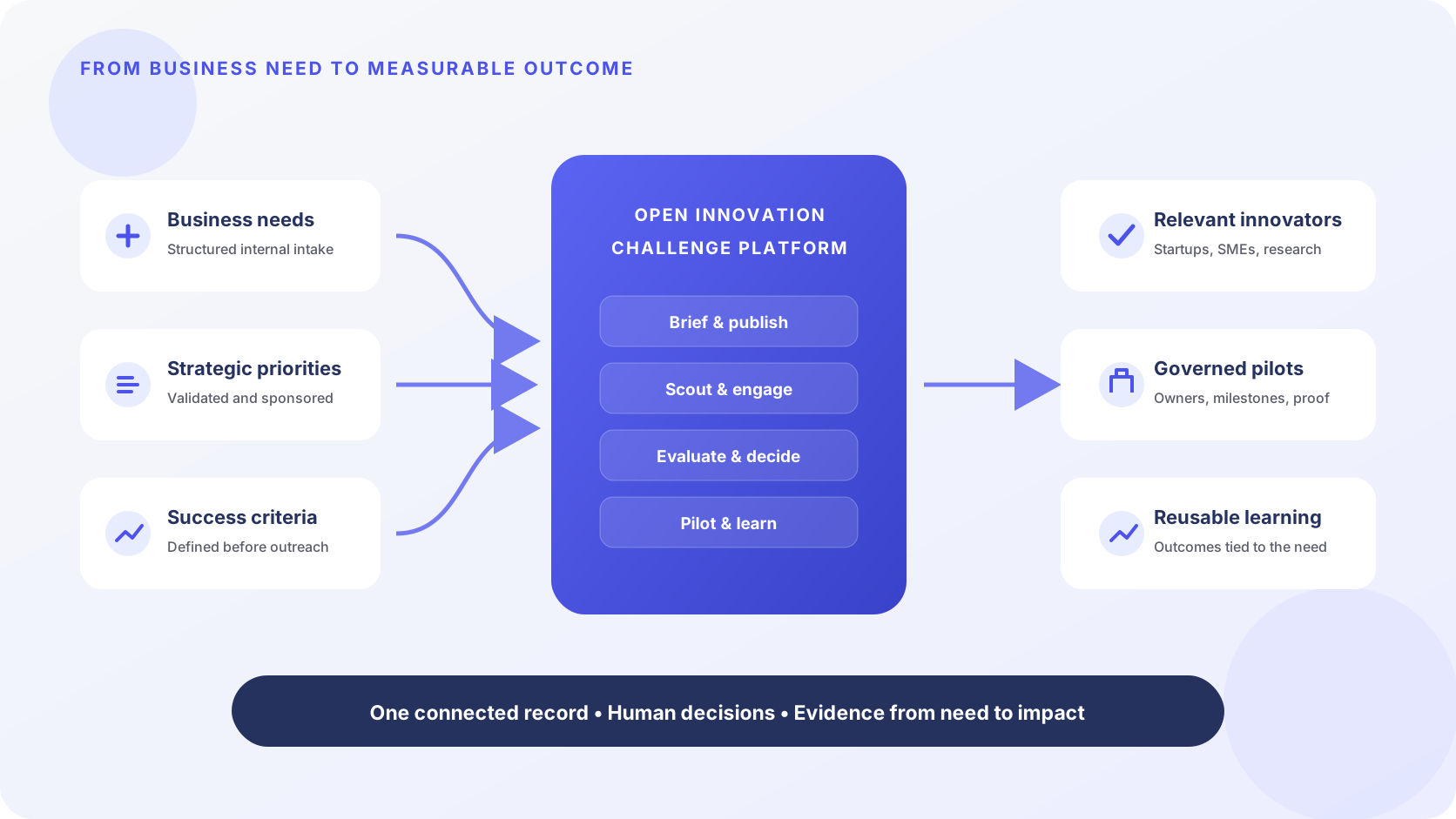
An open innovation challenge platform is a governed digital environment that connects an organisation's internal business needs with external startups, scaleups, SMEs, researchers and solution providers. It supports the complete journey: challenge intake and validation, brief creation, open calls and scouting, structured evaluation, pilot governance and outcome tracking.
The public call is the visible part of an innovation challenge. The harder work usually happens before and after it. Internally, teams must agree which problems matter, who owns them and what success would mean. Externally, they must reach relevant innovators, compare unlike proposals fairly and give selected teams a credible route to a pilot. Finally, they must retain the evidence: what was tried, what worked and whether the original need was met.
When those activities live in disconnected forms, inboxes, slide decks and spreadsheets, every handoff loses context. A connected open innovation platform creates a single record from need to outcome. It does not automate accountability; it makes accountability easier to see and manage.
In this guide
- Why programmes break before launch
- The seven-stage workflow
- Capture and validate internal needs
- Create the innovation brief
- Publish, scout and engage
- Evaluate and decide
- Govern pilots and retain learning
- Where AI helps
- Compare platform options
- Measure programme performance
- Frequently asked questions
Why innovation programmes often break before the external call
Organisations rarely lack ideas or problems worth solving. They lack a reliable mechanism for turning scattered internal needs into challenges that external innovators can understand and act on.
A business unit may describe the same underlying issue differently from another team. A senior sponsor may propose a solution before the problem has been validated. Technical, legal and procurement stakeholders may enter only after an external call has been drafted. By that point, important constraints appear late, the brief changes and applicant confidence falls.
This is not just an administrative problem. Research on external knowledge integration finds that valuable outside knowledge does not move into organisations automatically; internal project teams still have to overcome organisational barriers and embed it in their work.1 Discovery without internal ownership therefore produces activity, not adoption.
A systems approach offers a better model. ISO's innovation-management guidance treats innovation as a set of interrelated elements and activities, with value realised through deployment, adoption and impact—not merely idea generation.2 For a corporate or public-sector challenge programme, that means designing the internal and external workflow together.
The central design principle Do not start with “How do we launch a call for startups?” Start with “How will a validated business need move through discovery, decision, pilot and learning—with a named owner at every gate?”
The seven-stage open innovation workflow
A practical workflow has seven connected stages. The labels can vary between organisations, but the decision logic should remain consistent.
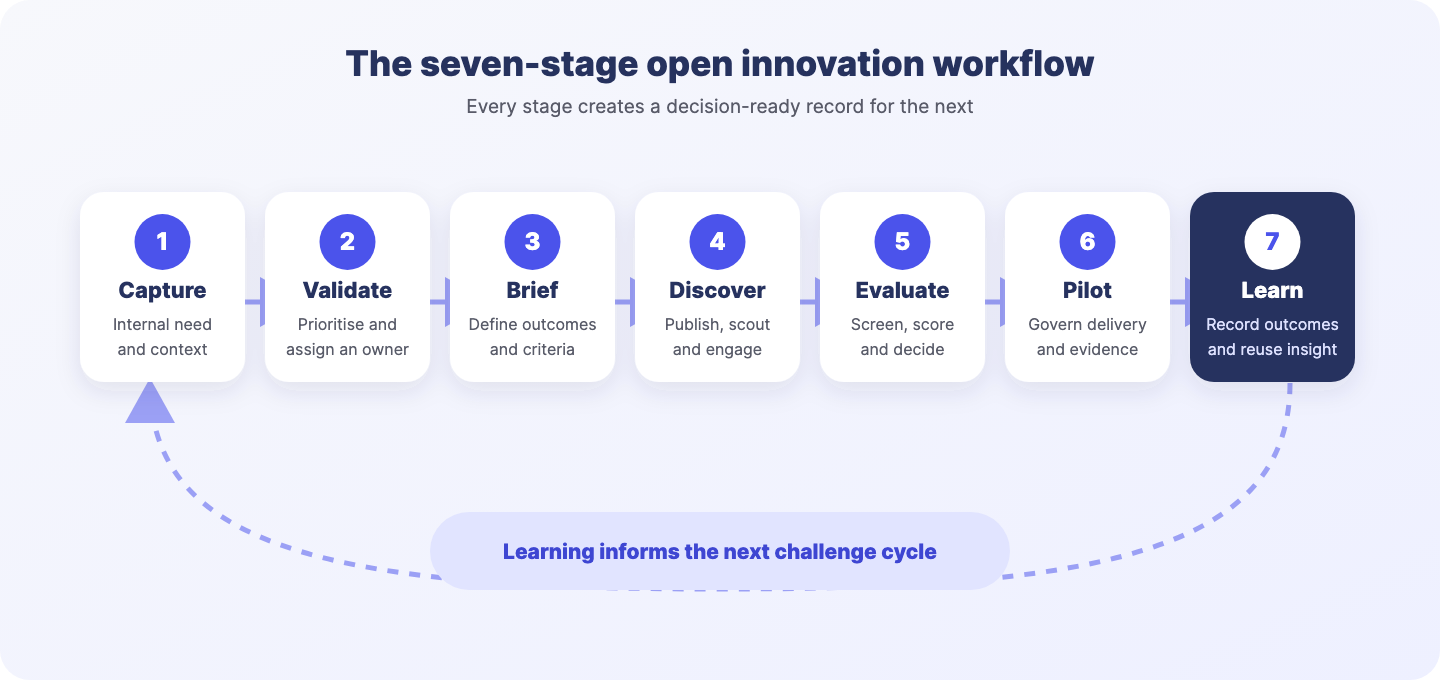
- Capture the internal need. Give teams a structured route to explain the problem, its context, the current workaround, expected value and practical constraints.
- Validate and prioritise. Identify overlaps, test strategic relevance, assess readiness and assign an empowered business owner.
- Create the innovation brief. Translate the validated need into outcome language, participation requirements, pilot parameters and evaluation criteria.
- Publish the opportunity and scout. Combine a branded open call with targeted outreach to relevant startups, scaleups, SMEs, researchers and solution providers.
- Screen, evaluate and decide. Apply proportionate eligibility checks, role-based review and documented decision gates.
- Govern the pilot. Connect the selected solution to agreed milestones, data access, risks, responsibilities and success measures.
- Record outcomes and reuse learning. Link results back to the original need and preserve supplier, evaluator and pilot intelligence for future programmes.
This sequence is compatible with established innovation-management models. ISO guidance describes a progression from identifying opportunities and creating concepts through validation, development and deployment.3 The key addition for an open innovation challenge is explicit external engagement: publishing the need, finding relevant innovators and evaluating their evidence in a governed environment.
Stages 1–2: Capture and validate internal business needs
The quality of the external challenge cannot exceed the quality of the internal need behind it. Structured intake is therefore not bureaucracy; it is the foundation for prioritisation, deduplication and a credible brief.
Ask for decision-useful information
A useful internal challenge form should capture:
- The problem: what is happening, who experiences it and why it matters.
- Evidence: available data, examples, prior attempts and the current workaround.
- Strategic relevance: which objective, operational priority or customer outcome the need supports.
- Constraints: technical environment, regulation, security, geography, timing and dependencies.
- Desired outcome: the change the organisation wants to observe, without prescribing a single solution too early.
- Ownership: the business sponsor, subject-matter contacts and the team capable of supporting a pilot.
Free text still has a role, but structured fields make needs comparable. They also let an innovation team see recurring themes across business units instead of treating every submission as an isolated request.
Separate triage from approval
Triage asks whether the submission is complete, relevant and potentially suitable for external innovation. Validation asks whether it is a genuine priority with an owner and a viable route to action. Those are different decisions and may involve different people.
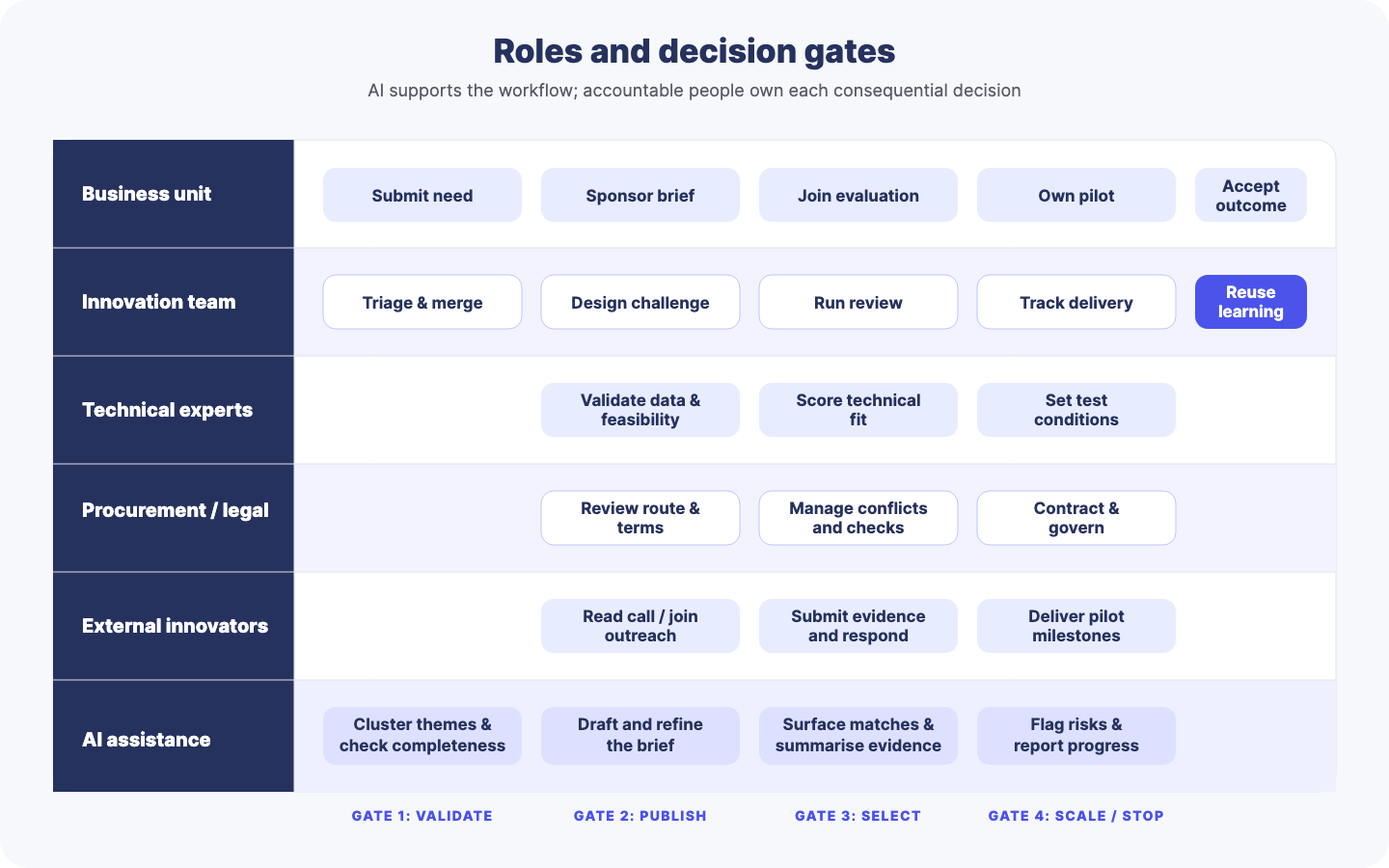
Innovation teams can cluster related needs and prepare recommendations. Business owners confirm operational value. Technical experts test feasibility and data availability. Procurement or legal colleagues advise on the appropriate engagement route and foreseeable conditions. A challenge should progress only when the organisation is prepared to respond if the market produces a credible answer.
Decision gate 1 — validate: Is the problem evidenced, strategically relevant, suitable for external engagement and backed by an owner with the capacity to support a pilot?
Skipso's open innovation platform can provide the structured intake, workflow stages, permissions and shared records needed to manage this internal front end before an opportunity becomes public.
Stage 3: Turn the need into a well-scoped innovation brief
An innovation brief is not simply a polished version of the original submission. It is the contract of understanding between the organisation, prospective innovators and the people who will evaluate them.
A strong brief explains the operational context in plain language, defines the outcome sought and makes important boundaries visible. It gives innovators enough information to judge whether they can contribute while preserving room for approaches the buyer may not have considered.
The six components of a decision-ready brief
- Problem and users: who experiences the issue, in what environment and with what consequences.
- Desired outcomes: the measurable change a successful solution or pilot should create.
- Scope and constraints: relevant systems, data, standards, exclusions and non-negotiable requirements.
- Target participants: the organisations or teams eligible to respond, described broadly enough to avoid excluding unexpected capability.
- Engagement proposition: what selected applicants receive, what is expected of them and the intended route to a pilot or further commercial discussion.
- Evaluation model: criteria, evidence requirements, stages, timetable and decision owners.
Write evaluation criteria while writing the brief, not after applications arrive. If “integration readiness” will influence the decision, the application must ask for the evidence needed to assess it. If a question does not inform a criterion or governance requirement, consider removing it.
Skipso's guide to running an innovation challenge explores the wider programme-design choices, including challenge framing, participant engagement and evaluation.
Decision gate 2 — publish: Is the brief clear, proportionate and approved by the business owner and relevant technical, legal, procurement and communications stakeholders?
Stage 4: Publish the open call, scout and engage
A call for startups platform provides a branded destination where external organisations can understand the challenge, test their fit and submit evidence. But an open page alone does not guarantee that the most relevant innovators will find it.
The strongest discovery strategy combines two routes:
- Open applications widen access and allow unfamiliar organisations to self-identify. Clear eligibility rules, accessible language and a proportionate first-stage form reduce avoidable friction.
- Proactive scouting searches for startups, scaleups, SMEs, research teams and specialist providers whose capabilities match the need, then invites them into the same evaluation process.
This combined model is already visible in public innovation infrastructure. Singapore's IMDA describes an Open Innovation Platform that helps organisations diagnose business challenges, crowdsource solutions from companies and research institutes, co-evaluate proposals and validate or test selected solutions.4 The important pattern is the connection between a well-defined need, broader market reach and a path to testing.
Design the applicant experience in stages
Do not ask every applicant for pilot-stage due diligence on day one. The first form should collect enough signal for an informed screening decision: solution relevance, evidence of capability, maturity, team fit and any essential eligibility conditions. Deeper technical, commercial and compliance questions can appear for organisations that progress.
A startup programme platform can centralise opportunity pages, applications, communications, reusable organisation profiles and programme stages. This gives applicants a consistent experience and programme teams a single source of truth.
Stage 5: Evaluate proposals consistently and make defensible decisions
Evaluation must accommodate different kinds of evidence without becoming arbitrary. A technical expert may assess feasibility, a business owner may assess operational fit, and procurement or legal specialists may identify constraints. The platform should let each role contribute at the right stage while preserving the rationale for the final decision.
Use criteria that reflect the intended decision
A typical first-round scorecard might combine:
- Problem–solution fit: how directly the proposal addresses the stated need.
- Evidence and maturity: what supports the claims and whether the solution is ready for the proposed test.
- Technical feasibility: compatibility with the environment, data and implementation constraints.
- Strategic and operational fit: relevance to the organisation and likelihood of internal adoption.
- Team and delivery capability: whether the applicant can support a credible pilot.
- Potential value and scalability: the plausible benefit and route beyond a successful test.
Weights and evidence standards should be tailored to the challenge. The Skipso innovation challenge evaluation scorecard guide explains how to translate objectives into criteria, rating scales and reviewer guidance.
Make the review process transparent to its participants
Reviewers need a clear brief, defined scoring anchors and a way to declare conflicts of interest. Programme managers need visibility of incomplete reviews, score variation and comments. Applicants need accurate expectations about stages and timing. Blind review may be appropriate where identity could create bias, but it is a programme design option—not a universal requirement.
For UK public-sector organisations, the Procurement Act 2023 provides for an open procedure and a competitive flexible procedure. Government guidance notes that the flexible procedure can be designed for areas such as innovation or product development.5 The correct route depends on the facts, value and legal context; the workflow platform should support transparency and auditable records, not substitute for procurement advice.
Decision gate 3 — select: Has each proposal been assessed against agreed criteria, have conflicts and material risks been handled, and is the selection rationale documented?
Stages 6–7: Govern the pilot and retain organisational learning
Selection is a transition, not the finish line. A promising proposal must become a testable engagement with an owner, milestones, access to the right users or data and a decision planned for the end.
Connect pilot measures to the original need
If the challenge sought to reduce an operational delay, the pilot should test that outcome or a defensible leading indicator—not a convenient activity metric introduced later. The original need, success criteria, evaluation record and pilot plan should remain linked.
A useful pilot record includes:
- the hypothesis and scope being tested;
- the business owner and delivery contacts;
- baseline data, target measures and evidence sources;
- milestones, dependencies, risks and decisions;
- commercial, data, security and intellectual-property arrangements; and
- agreed end states: scale, extend, redirect, retain for later or stop.
The European Innovation Council's Innovation Procurement Programme illustrates this need-to-pilot logic: participating buyers define challenges, companies compete through open calls and selected solutions progress to proof-of-concept or pilot activity, with deployment considered beyond the test.6
Make “stop” a useful outcome
A disciplined pilot can produce valuable evidence even when a solution does not scale. The organisation may learn that the integration cost is too high, the business process needs redesign first, the success measure was unrealistic or a different capability is required. Recording that conclusion prevents another team from repeating the same experiment without context.
Skipso's configurable programme management capabilities can keep stages, tasks, communications, evaluations and outcome data connected across the programme lifecycle.
Decision gate 4 — scale, extend or stop: What did the pilot demonstrate against the original need, what evidence supports the decision and what should the organisation reuse?
Where AI helps—and where human judgement must remain
AI is most valuable when it helps people work through large amounts of structured and unstructured information. It should increase coverage, consistency and speed while keeping consequential decisions attributable to people.
Practical uses across the workflow include:
- Challenge intake: identify similar submissions, suggest thematic clusters and flag missing information.
- Brief development: create a first draft from approved inputs, test clarity and suggest questions aligned with evaluation criteria.
- Scouting and matching: find possible innovators, compare public capability signals with the brief and explain why a result may be relevant.
- Application analysis: summarise evidence, identify where a response addresses a criterion and flag statements requiring reviewer attention.
- Portfolio reporting: reveal recurring needs, stalled stages, pilot patterns and gaps in the innovation portfolio.
Human owners should still validate priorities, approve public briefs, resolve conflicts, interpret evidence, select participants and make pilot or commercial decisions. NIST's AI Risk Management Framework emphasises documented roles and responsibilities for human–AI oversight and accountability.7 That is a useful principle for innovation programmes even where the AI use case is comparatively low risk.
Skipso AI for Innovation is designed to support activities such as challenge analysis, scouting, application review and programme insight within a governed workflow.
Generic tools, startup scouting software or an open innovation challenge platform?
The right technology depends on where the process begins and ends. A research database may be enough for a one-off shortlist. A form and project board may work for a small internal experiment. A repeatable enterprise or government programme needs continuity across stakeholders, decisions and cycles.
What to look for in open innovation software
- End-to-end workflow: internal challenge intake, external calls, scouting, evaluation, pilot tracking and outcome reporting in one environment.
- Configurable branded experiences: different forms, journeys and portals for business users, applicants, reviewers and partners.
- Stage-gated data collection: proportionate questions and checks that deepen as an opportunity progresses.
- Structured evaluation: configurable scorecards, reviewer assignments, comments, conflicts, moderation and decision records.
- Role-based access and auditability: appropriate visibility, timestamps and ownership across internal and external stakeholders.
- Reusable ecosystem intelligence: organisation profiles, interactions, previous submissions, assessments and outcomes that remain searchable.
- Human-centred AI assistance: transparent support for clustering, drafting, matching, analysis and reporting with human approval gates.
- Integration and enterprise readiness: security, accessibility, data governance and a clear handoff to procurement and delivery systems.
An innovation challenge management platform should not force every programme into one template. The durable capability is a governed system that can adapt its stages, forms, evaluation logic and participant experience while preserving consistent data and oversight.
How to measure the performance of the workflow
Application volume alone is a weak measure of programme value. Track the complete path from internal need to outcome and use operational metrics to identify where the workflow is losing momentum.
Need quality
Completeness, strategic alignment, duplicate themes, validated challenges and percentage with an active business owner.
Market access
Relevant innovators reached, qualified applications, new-to-organisation participants and representation across target segments.
Decision process
Time between gates, reviewer completion, scoring consistency, conflicts resolved and applicant communication timeliness.
Pilot readiness
Selected proposals entering a pilot, time to pilot start, baseline measures agreed and dependencies cleared.
Outcome and adoption
Pilots completed, evidence against the original need, scale or procurement decisions and measurable operational value.
Organisational learning
Profiles and evidence reused, recurring needs identified, repeated mistakes avoided and insights applied to later challenges.
Metrics should help teams improve the programme, not reward activity for its own sake. A lower application count with stronger relevance may be better than a large, poorly matched funnel. A stopped pilot with well-recorded evidence may be more valuable than an extended pilot with no decision.
Frequently asked questions
What is an open innovation challenge platform?
It is software that helps an organisation capture and validate internal business needs, publish innovation challenges, scout external innovators, manage applications, evaluate proposals, govern pilots and retain outcomes in one connected record.
What is a call for startups platform?
A call for startups platform is the external engagement layer used to publish opportunities and receive startup applications. It may be part of a broader open innovation challenge platform, which also manages the internal need, review workflow, pilot and learning before and after the public call.
How is an open innovation platform different from startup scouting software?
Startup scouting software generally focuses on finding and researching companies. An open innovation platform may include scouting but continues into applications, evaluation, collaboration, pilot governance and outcome tracking. The distinction is the breadth of the workflow, not just the label used by a vendor.
Should a programme use open applications or proactive startup scouting?
Usually both. Open applications widen access and allow unfamiliar organisations to self-identify. Proactive scouting reaches relevant innovators who may not see the call. All candidates should enter a clear and consistent assessment process.
Can AI evaluate startup applications?
AI can help organise, summarise and compare submitted evidence against defined criteria. It can flag missing information and surface possible matches. Accountable people should review the evidence, resolve ambiguity and make selection, pilot and commercial decisions.
Does an innovation challenge platform replace procurement software?
No. It manages the uncertain journey from business need to validated external solution and pilot. Formal tendering, contracting, purchasing and payment may remain in procurement or source-to-pay systems. The boundary and handoff should be agreed early.
How long does an open innovation challenge take?
It depends on the complexity of the need, market-engagement period, number of evaluation stages, stakeholder availability and route to pilot. A platform cannot remove necessary governance, but it can expose ownership and status so avoidable delays are easier to manage.
What information should an internal challenge submission contain?
At minimum: the problem, affected users or process, available evidence, current workaround, strategic relevance, constraints, desired outcome and a named owner capable of supporting the next stage.
Build the workflow around the decision, not the launch
A successful open innovation programme is not defined by the moment its call goes live. It is defined by whether the organisation can trace a line from a real internal need to relevant external capability, a fair decision, a well-governed pilot and an evidence-based outcome.
The best open innovation challenge platforms make that line visible. They reduce the handoff gaps between business units, innovation teams, experts, procurement colleagues and external innovators. They retain the knowledge created by every application and pilot. Most importantly, they help the organisation turn external engagement into a repeatable operating capability rather than a series of disconnected campaigns.
Key takeaways
- An open innovation challenge platform connects internal needs, external innovators, evaluation, pilots and outcome tracking in one governed workflow.
- Challenge quality depends on structured intake, clear ownership and validation before an external call is published.
- Open applications and proactive scouting work best together when every candidate enters a consistent evaluation process.
- AI can organise information, surface matches and support analysis, while accountable people retain decision authority.
- Programme performance should be measured from internal need to pilot outcome—not by application volume alone.
Connect your innovation workflow from need to outcome
See how Skipso can support challenge intake, scouting, applications, evaluation, pilots and programme intelligence in one configurable platform.
Sources and further reading
- Fraunhofer: Organisational barriers to external knowledge integration in open innovation
- ISO/TC 279: Published innovation management standards
- ISO: Innovation management system—practical guide
- Infocomm Media Development Authority: Open Innovation Platform
- UK Government: Procurement Act 2023 guidance on competitive tendering procedures
- European Innovation Council: Innovation Procurement Programme
- NIST: AI Risk Management Framework Core


Not sure where to start?
Tell us what you are trying to run. We will help map it to the right
program, ecosystem, AI, or GRAITR setup.


