





Role of Government in Innovation: Complete Guide
More than eighty percent of american innovation breakthroughs trace their roots to government involvement in research and policy. Whether you follow new medical discoveries or the latest tech startups, the impact of government support touches every step of progress. Understanding how government shapes, funds, and partners with emerging ideas can reveal why some regions outpace others in technological and economic advancement.
Table of Contents
- Defining The Role Of Government In Innovation
- Types Of Government Innovation Initiatives
- Key Policies And Funding Mechanisms
- Government Partnerships With Private Sector
- Risks, Challenges, And Success Factors
Key Takeaways
| Point | Details |
|---|---|
| Government’s Role in Innovation | Governments are essential in fostering innovation through funding, policy frameworks, and support for research institutions. |
| Types of Initiatives | Key government initiatives include research grants, tax incentives, and public-private partnerships, which stimulate technological advancement. |
| Partnership Dynamics | Effective government-private sector partnerships rely on strategic alignment and knowledge exchange, enhancing collaborative innovations. |
| Addressing Challenges | Governments must navigate market uncertainties and align diverse stakeholder expectations to successfully implement innovation strategies. |
Defining the Role of Government in Innovation
Governments play a pivotal role in driving technological progress and economic development by strategically addressing market limitations and fostering an environment conducive to innovation. According to Cambridge Core, governments fundamentally aim to protect and improve public welfare through systematic technological innovation support.
The core mechanisms through which governments influence innovation include:
- Direct funding of research and development (R&D) programs
- Creating policy frameworks that incentivize technological advancement
- Supporting public research institutions
- Establishing legal and regulatory environments that encourage entrepreneurial activities
As explored in Academic Oxford, governments specifically address critical market failures by investing strategically in public research infrastructure. This approach helps overcome significant barriers that private sector entities might find financially challenging or too risky to pursue independently.
Government innovation strategies typically operate through multiple channels: providing targeted grants, offering tax incentives for research investments, facilitating technology transfer between academic and commercial sectors, and creating collaborative platforms that bring together researchers, entrepreneurs, and industry leaders. By developing these interconnected support systems, governments can effectively stimulate technological progress while simultaneously addressing broader societal and economic objectives.
Types of Government Innovation Initiatives
Government innovation initiatives represent sophisticated strategic approaches designed to accelerate technological advancement and economic growth across multiple sectors. ArXiv Research highlights how these programs can catalyze cooperative activity through mechanisms that strategically promote self-organization within innovation networks.
The primary types of government innovation initiatives include:
- Research Grants and Funding Programs: Direct financial support for cutting-edge scientific and technological research
- Tax Incentive Schemes: Financial benefits for companies investing in research and development
- Innovation Accelerator Programs: Structured support environments for emerging technological ventures
- Public-Private Partnership Initiatives: Collaborative frameworks bridging government resources with private sector expertise
- Technology Transfer Programs: Mechanisms facilitating knowledge exchange between academic institutions and industry
These initiatives typically operate through comprehensive strategies that address multiple innovation ecosystem requirements. By designing targeted interventions, governments can systematically reduce barriers to technological progress, create supportive regulatory environments, and stimulate entrepreneurial activity across diverse industries.

Successful government innovation initiatives often focus on building robust infrastructure that connects researchers, entrepreneurs, investors, and policymakers. Research on Innovation Networks demonstrates that effective programs create interconnected platforms where knowledge, resources, and opportunities can be shared seamlessly, ultimately driving national technological competitiveness and economic resilience.
Key Policies and Funding Mechanisms
Government innovation policies and funding mechanisms represent sophisticated strategic tools designed to systematically transform technological landscapes and drive economic progress. Randwick Research demonstrates how targeted policies can effectively promote innovation diffusion by establishing robust service platforms and strengthening critical collaboration networks between industries, universities, and research institutions.
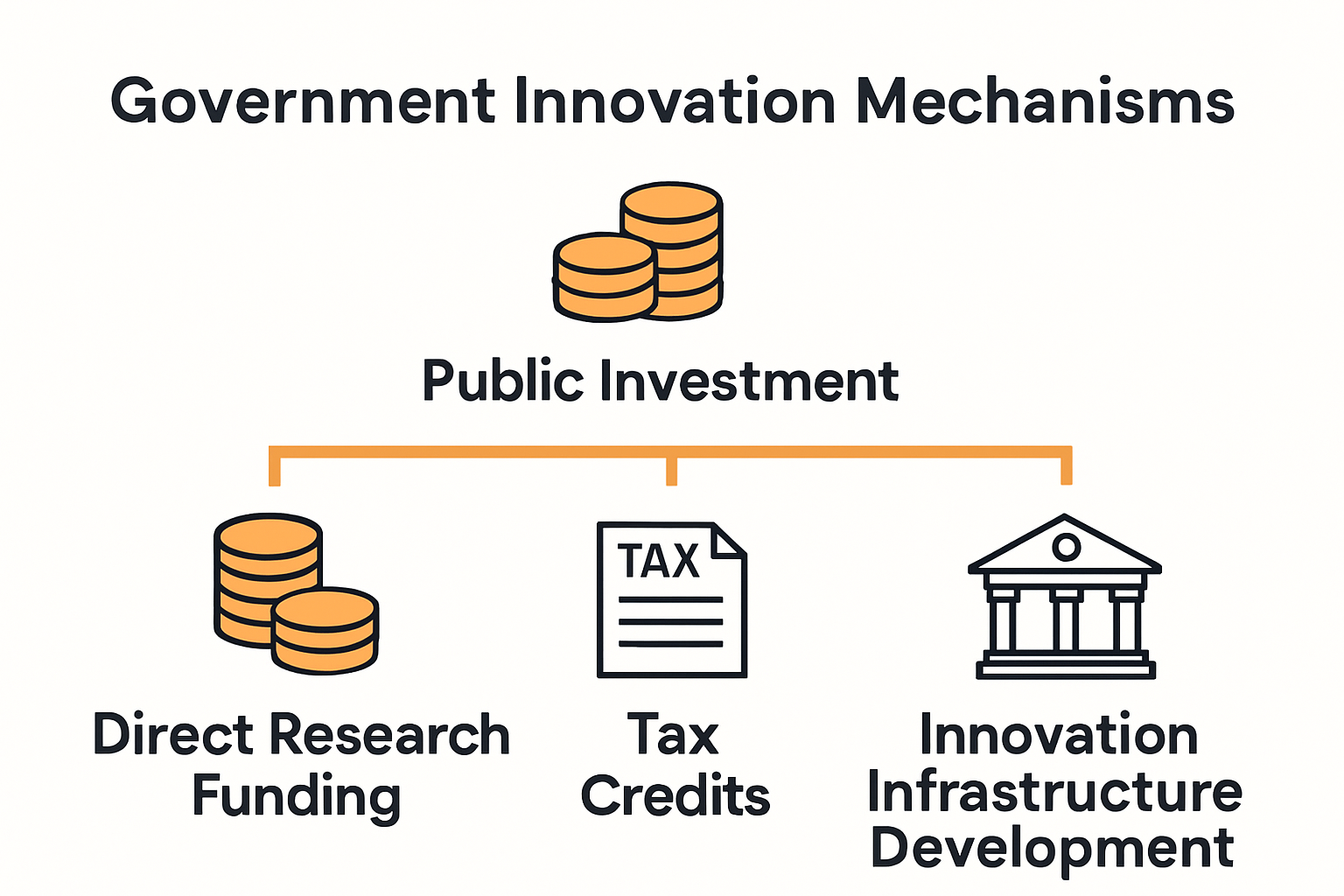
The primary policy and funding mechanisms typically encompass:
- Direct Research Funding: Comprehensive financial support for scientific and technological research projects
- Tax Credit Incentives: Financial benefits encouraging private sector research investments
- Collaborative Grant Programs: Structured funding that promotes cross-sector knowledge exchange
- Innovation Infrastructure Development: Investments in technological ecosystems and research facilities
- Intellectual Property Protection Frameworks: Legal mechanisms safeguarding innovative developments
ArXiv Research highlights how public sector organizations can further accelerate innovation through policies enabling open cross-sector data sharing and collaborative software development. These approaches create dynamic environments where knowledge transfer becomes seamless and technological barriers are systematically dismantled.
Successful implementation of these mechanisms requires a holistic approach that balances strategic financial support with flexible regulatory frameworks.
 Government Grant Management demonstrates that effective innovation policies must continuously adapt, creating responsive systems that can rapidly integrate emerging technological trends while maintaining rigorous evaluation and accountability standards.
Government Partnerships With Private Sector
Government partnerships with the private sector represent sophisticated collaborative frameworks designed to drive technological innovation and economic growth. ArXiv Research highlights how public sector organizations are increasingly developing intricate collaboration models that facilitate comprehensive data sharing and co-development of innovative software solutions across organizational boundaries.
Key characteristics of effective government-private sector partnerships include:
- Strategic Alignment: Shared goals and complementary technological objectives
- Risk Sharing: Distributed financial and technological risks
- Knowledge Exchange: Seamless transfer of expertise and research insights
- Resource Pooling: Combined technological and financial capabilities
- Regulatory Flexibility: Adaptive frameworks supporting collaborative innovation
These partnerships typically manifest through multiple engagement models, ranging from direct research collaborations to complex innovation ecosystem development. How to Manage Partnerships demonstrates that successful collaborations require robust communication channels, clear performance metrics, and mechanisms for continuous mutual value creation.
The most transformative government-private sector partnerships go beyond traditional transactional relationships, creating dynamic platforms where public sector strategic vision meets private sector agility. By establishing these interconnected innovation networks, governments can accelerate technological advancement, address complex societal challenges, and create sustainable economic value that transcends individual organizational capabilities.
Risks, Challenges, and Success Factors
Randwick Research emphasizes that government innovation initiatives face complex challenges, particularly the critical need to proactively create new markets rather than merely supervise existing ones. This requires sophisticated policy approaches that go beyond traditional regulatory frameworks and actively shape technological and economic landscapes.
Key risks and challenges in government innovation efforts include:
- Market Uncertainty: Navigating unpredictable technological trajectories
- Regulatory Complexity: Balancing oversight with innovation acceleration
- Resource Allocation: Strategically distributing limited funding
- Technological Obsolescence: Keeping pace with rapidly evolving innovations
- Stakeholder Alignment: Managing diverse expectations across public and private sectors
ArXiv Research identifies critical governance challenges, highlighting the intricate complexities of accelerating self-organization within strategic industries. Successful innovation ecosystems require nuanced network governance that can adapt quickly to emerging technological trends while maintaining robust accountability mechanisms.
Understanding Corporate Innovation Challenges demonstrates that success factors typically involve creating flexible policy frameworks, establishing clear performance metrics, and developing responsive communication channels between governmental bodies and innovative enterprises. By cultivating an environment that simultaneously supports risk taking and maintains strategic oversight, governments can effectively transform potential challenges into opportunities for technological advancement.
Empower Government Innovation with Skipso’s Proven Platform
Government innovation efforts often face challenges such as navigating complex regulations, managing limited funding, and coordinating diverse stakeholders to build robust ecosystems. This guide highlights the need for flexible policy frameworks and seamless collaboration that drive self-organized networks and accelerate technological progress. If your goal is to overcome market uncertainties, streamline grant management, and foster productive public-private partnerships then embracing an integrated innovation management solution is essential.

Discover how Skipso can empower your government innovation initiatives by providing a comprehensive platform designed to manage the entire innovation lifecycle. From running targeted grant programs to building vibrant ecosystems that connect researchers, entrepreneurs, and policymakers Skipso enables you to turn strategic goals into measurable outcomes. Act now to transform complex innovation challenges into sustainable growth with Skipso. Learn more about managing innovation with our full-featured platform and advance your mission through effective grant management solutions. Take control of your innovation journey today.
Frequently Asked Questions
What is the role of government in fostering innovation?
Governments play a key role in fostering innovation by providing funding for research and development, creating policy frameworks that incentivize technological advancement, and supporting public research institutions.
What types of funding mechanisms do governments use to promote innovation?
Governments typically use direct research funding, tax credit incentives, collaborative grant programs, and innovation infrastructure development to promote innovation.
How do government partnerships with the private sector accelerate innovation?
Government partnerships with the private sector facilitate knowledge exchange, resource pooling, and risk sharing, which can lead to accelerated technological advancement and economic growth.
What are the main challenges faced by government innovation initiatives?
Key challenges include market uncertainty, regulatory complexity, resource allocation, technological obsolescence, and managing stakeholder alignment.


